Saturday, August 7, 2010

"Bak Kut Teh" Noodle( 肉骨茶面)

“Bak Kut Teh” is a herbal pork rib soup eaten with rice and hot Chinese tea. In the olden days, this dish was supposedly a healthy and “balanced” food for the poor Chinese coolies working at the ports and fishermen who were out in the windy open seas.

The herbal pork rib soup helps to increase the metabolism rate and also keep the body warm. The tea (teh)  balances and helps to  neutralize the heatiness and fats in the pork when consumed. The tea must be sipped in between bites of pork ribs to get the maximum effect. That is why Chinese tea is usually served in dainty teacups.


Tea is a solvent for fats/oil. For the “Bak Kut Teh” connoisseur, good Chinese tea is a must to go with the dish. If one drinks sufficient amount of tea, there is no health issue eating “Bak Kut Teh” frequently.

I prefer drinking the “Bak Kut Teh” herbal soup to eating the stewed ribs. There are many instant ‘Bak Kut Teh” soup packs in the market. Some are grounded herbs combination in paper bags for cooking. Others come in spray-dry powder form that just dissolves in boiling water.

I love  “Bak Kut Teh” noodles cooked with vegetables, “tofu pok” (deep fried beancurd) or fried pork skin, chicken fillet and mushrooms.

It is a wholesome meal that keeps me alert and I don’t even need coffee the whole afternoon after eating the “Bak Kut Teh” soup noodles for lunch!


Ingredients (for two servings):-

2 packets of “Bak Kut Teh” instant noodle.
250 gram of chicken fillet
200 gram of baby Pak choy( 小白菜)or Chinese romancee (Yeaw mak油麦) vegetable
4 pieces of Shitake mushroom( 香菇)pre-soaked
80 gram of fried pork skin(炸猪皮) pre-soaked & cut into 2” X 2” square
1 teaspoon of sesame oil(麻油).
¼ teaspoon of Ikan bilis( 江鱼)powder.
¼ teaspoon of pepper( 胡椒)powder.


Preparation:

Boil 500ml of water. Once boiled, turn the temperature to low. Blanch the noodles alone until it is springy and loose. Remove with a sieve and place into serving bowls.  Then blanch the vegetable. Drain the water completely after blanching.

Rinse  the cooker thoroughly. Boil 600ml of water. Once boiled, turn the temperatue to low. Add in the sesame oil, pepper powder, ikan bilis powder, chicken fillet, shitake mushroom, pork skin and bring it to boiling point. Finally, add the seasoning pack that came with the instant noodle. Stir thoroughly.

Pour the soup into the bowls and serve.


See the wholesome and appetizing noodle for lunch in office.

Sunday, July 4, 2010

Fresh Prawn Noodles

Occasionally, my colleague will select and bring some choicest prawns from his father’s catch to the office.  Besides cooking fresh seafood porridge, I will cook prawn noodles. Just using the instant packet ‘Har Mee” to cook with the prawns is not good enough.  I will add some sambal belacan (fermented shrimp with chilli mashed into paste form) and ikan bilis (anchovy) powder.  And if kangkong or water convolvulus (vegetable) is available, this will complete the Penang prawn mee recipe.

Ingredients (for two servings):-
2 packets of “Har Mee” instant noodles.
6 pieces (250 gm) of large fresh white prawns
1 table spoon of sambal belacan.
1 teaspoon of sesame oil.
¼ teaspoon of Ikan bilis powder.

Preparation:

Boil 500ml of water. Once boiled, turn the temperature to low. Blanch the noodles alone until it is springy and loose. Remove with a sieve and place into serving bowl.  Then blanch the kangkong. Throw away the water after blanching the kangkong.

Rinse  the cooker thoroughly. Boil 600ml of water. Once boiled, turn the temperatue to low, add in the prawns, sambal belacan and continue to boil until the prawns are cooked. Next, add the sesame oil, ikan bilis powder and seasoning pack from the instant noodles. Stir thoroughly and remove the prawns. Do not over-cook the seasoning.

Pour the soup onto the noodles and serve.

This is the most delicious prawn noodles that I have tasted. The best prawn noodles in Penang only gives you a few slices of prawn or some tiny shrimps plus a few slices of pork. And it does not taste as good as this.   

Sunday, June 13, 2010

Instant Noodles - it is not boring at all.

I will never go hungry in the office. I have a large drawer stocked with a variety of foodstuff, such as biscuits, chocolate,  oats, milk powder, sugar, cereal, 3in1 white coffee, chocolate and mueslli.  In addition to the instant food items, there are dried foodstuff like shitake mushroom, mussel, peanut, scallop, noodles and rice. Instant noodles is one item that one can find in every employee's drawer. 
If the weather is unkind or when I'm not in the mood  to cook lunch, I need not shout for help or go hungry. I can always fix a mug of cereal with milk or a cup of hot chocolate or white coffee with biscuits to fill my stomach.

Like all Malaysians, I love instant noodles. Instant noodles is not boring. How one cooks it and what ingredients added to it makes a great difference. Just twenty  minutes of cooking is required. I don’t go for the plain instant noodles with powder seasoning and flavour pack. I cook them with ingredients added and I get a bowl of 5-Star noodles. So far, I have cooked Prawn noodles, Chicken and Egg noodles and Bak Kut Teh noodles in the office. I will continue to experiment with other style of noodles.

Here is the Chicken and Egg noodles recipe for office cooking.


Ingredients (for one serving only):-
1 packet of oat noodles
1 fresh chicken egg
50 gm of chicken fillets
4 leaves of lettuce
Cut spring onion
Sesame oil
White pepper powder
Ikan Bilis powder


Preparation:-


Boil 500ml of water. Once boiled, turn the temperature to low. Blanch the noodles alone until it is springy and loose. Remove with a sieve and place into serving bowl. The water has turned yellowish and oily. This is the colouring and wax from the noodles.


Next blanch the lettuce (or any other vegetable). and place them with the noodles.


Now, the boiled water has turned yellowish green. Pour away the water and rinse the cooker thoroughly.


Boil 500 ml of fresh water.Add in the chicken fillet. Once cooked, transfer to a plate for shredding.


Turn the temperature of the cooker to low. Break the egg into the soup. Sprinkle some sesame oil, ikan bilis powder and pepper. Once the soup is bubbling, add in the flavour pack (from the instant noodle) and stir.


Pour the boiling soup onto the noodles and add in the shredded chicken and spring onion.


Lunch is ready. Look at my bowl of delicious and yummy shredded chicken and egg noodles! 


The picture above is chicken and egg noodles with lettuce.


The picture on the left is chicken and egg noodles with baby "pak choy".

Sunday, May 23, 2010

Shreded chicken porridge with salted and century eggs.

On any cold rainy afternoons, a bowl of steaming hot porridge would be ideal for lunch. It has been raining for the last couple of days as I prepare ingredients for my lunch tomorrow.

I have cut some young ginger strips and spring onions the night before and kept them in a small container in the fridge. I have also placed three pieces of chicken fillet in a separate container in the freezer.

Ingredients required for two servings:

1.    One cup rice
2.    Three pieces of chicken fillet (defrost) 125 gms
3.    One salted duck egg
4.    One century egg (Chinese preserved egg)
5.    ¼ Teaspoon cooking salt.
6.    ¼ Teaspoon ikan bilis powder.
7.    ¼ Teaspoon white pepper powder
8.    ½ Teaspoon sesame oil
9.     spring onion, cut.
10. young ginger strips.


Preparation.

Remove the black mud from the salted egg and wash thoroughly. Boil the salted egg and let it cool before removing the shell. Pour away the water and rinse the multi-cooker.

Rinse and drain rice with water and place in multi-cooker. Add ½ litre of water and set temperature to maximum. Once boiled, change the setting to medium heat. Continue to boil the porridge for another 1 ½ hours, stirring and adding a bit of water every 5 to 7 minutes until the content reach the l litre mark with the required viscosity of the porridge.

Put the chicken fillets into the porridge and cook for 3 minutes. Dish out and shred them using two forks.

Remove the shell from the boiled salted duck egg and the century egg. Rinse the eggs and cut to small pieces. You can either use a knife and a fork or a fork and a spoon to cut the eggs.

         
Add salt, anchorvy (ikan bilis) powder and pepper to the  porridge.  Stir and bring to boil.  Finally, add in the shredded chicken and cut eggs.

The porridge is now ready to be served.  Sprinkle some sesame oil, spring onion and ginger stripes.


One sip of the steaming hot porridge and you can feel the warmth dispersing in your abdomen. The aroma and the taste are superb. 


Sunday, May 9, 2010

Fresh Seafood Porridge

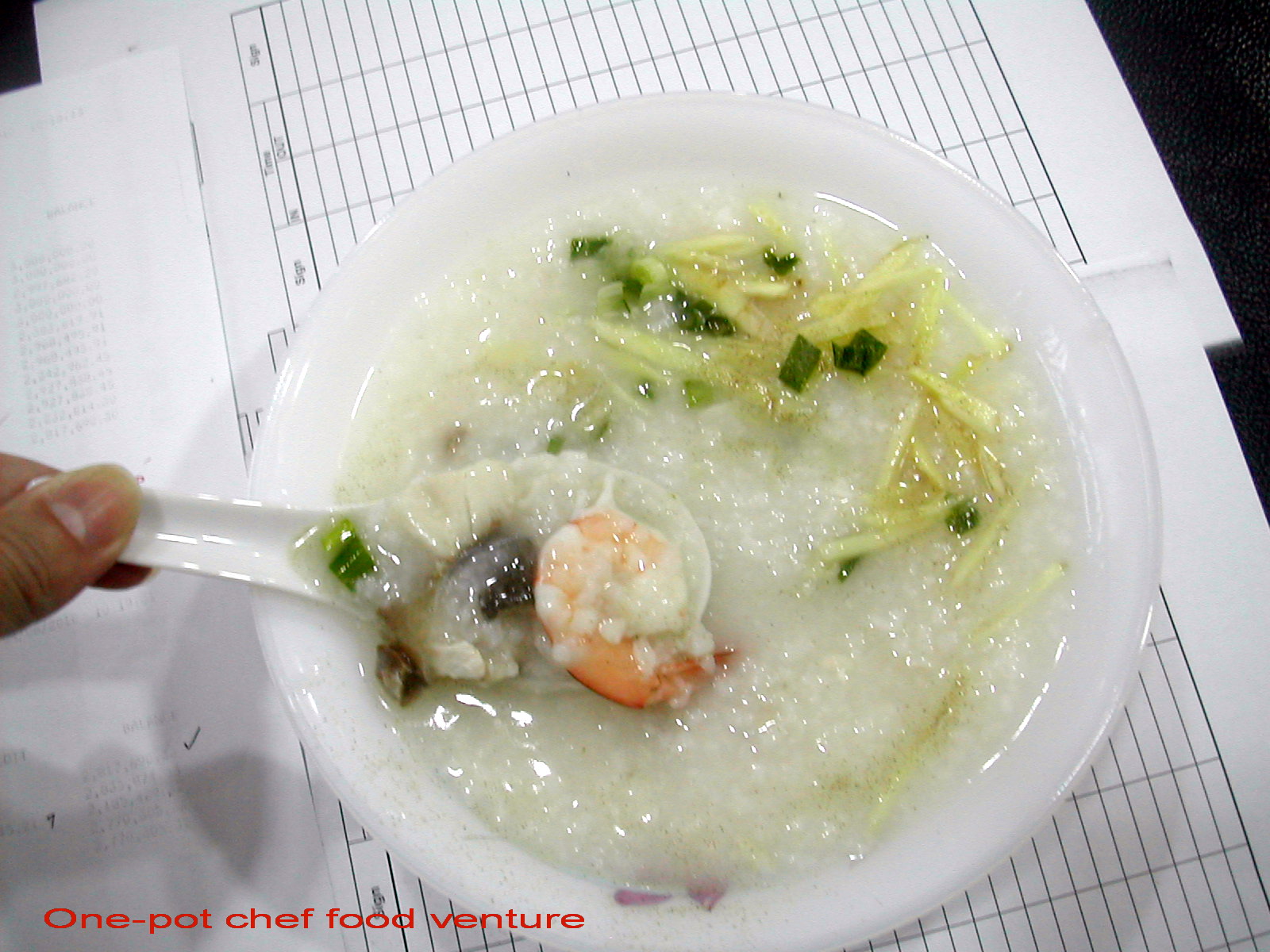
I have a colleague whose father owns a commercial fishing boat. Occasionally, he would bring some of the best catches from the sea to the office.   Knowing that I love to eat porridge, he would supply me the finest pick of fresh fish and prawns for my cooking. I would normally add a portion for him. His selected catch is really different from what you find in the wet market or super/hypermarket.  


Cooking fresh seafood porridge is easy but the timing is very important.

For two servings, the required ingredients are :-

1.    One cup of rice
2.    Two slices of Threadfin fish (Ikan Kurau or Ikan Senangin) 250gms
3.    Four large white prawns (udang putih) 200 gms
4.    ¼ Teaspoon of cooking salt.
5.    ¼ Teaspoon of Ikan bilis powder.
6.    ¼ Teaspoon of white pepper powder
7.    ½ Teaspoon of sesame oil
8.     spring onion, cut.
9.     young ginger strips.

Preparation.

Rinse and drain rice with water and place in multi-cooker, Add in ½ litre of water and start to boil at maximum temperature. Once boiled, set the temperature to medium. Continue to boil the porridge for another 1 ½ hours, stirring and adding a bit of water every 5 to 7 minutes until the content reach the l litre mark with the required viscosity of the porridge. Add the fish, prawn, salt, anchorvy (ikan bilis) powder and pepper.  Stir the porridge and bring to boil.  

The porridge is now ready to be served.  Sprinkle some sesame oil, cut spring onion and ginger strips.                


Hmmm….mmmm! This porridge is really the best I have ever tried so far. One bite on the succulent prawn and I can feel the natural sweet juice oozing out in my mouth. Delicious! I get the same sappy and heavenly feeling when my teeth sank into the fish. 


Friday, April 23, 2010

Cooking your own lunch in office


“Oh! It is so hot outside. How to go out for lunch?”

“So boring-lah, eating the same food everyday around this area.”  

“Any new food outlet we can go today?”.

“Don’t know what to eat for lunch-lah”.

These are common statements uttered in the office everyday..

              Recently, I discovered a new appliance in the household section of a hypermarket. This multi cooker cum kettle which has a litre capacity is ideal for cooking 1-2 servings. I can even eat directly from it. “Cool, isn't it?”  See the picture of my multi-cooker.

Most people hate washing up after cooking. So, use this appliance to overcome the problem. If you think this is not presentable, then pour out into a bowl. Then, you have one extra bowl to wash.

Why not cook your own food in the office pantry?  Unless your boss prohibits, it is so convenient to cook your own lunch. The food is so much more healthier and tastier too!

Here, I like to share a few simple but wholesome meal recipes for lunch in the office.

Prepare the ingredients at home. Pack them in small containers and keep them in the refrigerator in the pantry. If there is no fridge in the pantry, use an ice-packed container.

The simple to cook recipe for lunch is the “Dried scallop, dried mussel, peanut and century egg” porridge.

Ingredients:-

1.     One cup of rice, rinsed with water first.
2.     25 gram of dried mussels (pre-soaked)
3.     25 gram of dried scallop (pre-soaked)
4.     80 gram of shelled peanut (pre-soaked)
Do the pre-soaking in the morning upon reaching the office.
5.     one century egg (shell removed) cut into small pieces
6.     ¼ teaspoon of salt.
7.     ¼ teaspoon of ikan bilis (anchorvy) powder.
8.     One liter of water.
9.     Pepper and Sesame oil to taste.

Boil rice in the multi cooker together with the dried mussel, scallop and peanut at high temperature. Once boiled, turn the temperature setting to medium and boil for another one and a half hour. Stir the porridge every  5 -7 minutes to prevent the rice from sticking to the bottom of the pot.

Add in the salt, ikan bilis powder and the century egg.  Continue stirring and bring the porridge to boiling point before serving.

Sprinkle some pepper and a few drops of sesame oil to enhance the flavour.

See the yummy yummy porridge cooked in my office.  


Friday, October 16, 2009

Mee Suah” Thread noodle ( 面线)

Mee suah(面线) literally means thread noodle, is a very fine strand noodle made from buck wheat. This noodle originates from the Fujian province of China and is highly regarded by the Fujian people as a heavenly food. Mee suah is a must for the Fujian people’s birthday celebration. It is also widely presented as a gift for special occasions.

Traditionally, the mee suah is cooked with meat and served with two hard-boiled chicken eggs as a special meal for the birthday boy/girl.

When offering prayers to the Fujian deities or the God of Heaven, the mee suah is a must.

There are two well-known manufacturers of mee suah in Fujian, namely Sim Soon Huat and Fujian Foodstuff, Oil & Cereal Corporation. The mee suah are exported in neatly packed boxes of either 8 ounces or 12 ounces.

Recently, I discovered a hidden treasure in Malaysia. The Foozhou people from the Fujian province brought their mee suah making skills to a small little town in Malaysia.
They continue to make mee suah in a very traditional way - hand-made and sun dried. This place is Kampong Koh, Sitiawan. There are also a few mee suah specialty shops in Kampung Koh. In fact, the mee suah from Kampong Koh tastes so much better than the imported ones from China. Here, we have two varieties of mee suah. The thinner mee suah is sold at RM10.00 (USD2.75) per kg whilst the coarser type costs RM8.00 (USD2.20) per kg.

The Foozhou people usually cook mee suah with chicken meat and home-made red rice wine. This is the standard fare for Foozhou women during confinement after giving birth. It is a must-try dish for any visitor to a Foozhou family.

You can get good red rice wine mee suah from selected restaurants in Sitiawan and Sri Manjung in the state of Perak.

Cooking mee suah is easy but delicate. The noodle strand is very fragile and breaks easily. Cooking time and the temperature control is very important to prevent the mee suah from turning soggy.


Ingredients for five persons


1 box of mee suah (10 pieces)
100 gm minced pork
100 gm pork , sliced thinly
1 long strip of pork ball, cut to bite size
5 eggs
2 stalks spring onions, finely sliced
100 gm lettuce
2 liter water
1 tsp toong choy (preserved Chinese cabbage)
2 tsp tapioca flour
2cm ginger, smashed
salt, soy sauce, sesame oil, pepper

Cooking Method

1. Marinate the minced pork and pork slices separately with salt, soya sauce, pepper and sesame oil.
2. Boil toong choy, ginger and water in a pot.
3. Blanch the lettuce lightly and dish out.
4. Toss pork slices in tapioca flour and stir into stock.
5. Mix the minced pork in the remaining flour. Make small meatballs and stir into the soup.
6. Add salt to taste.
7. Scoop a single serving portion of the boiling soup into a separate saucepan.
8. Break one egg into the soup.
9. Lightly blanch the dry mee suah in a wok
10. Drain and add into the boiling soup with egg.


Serve the mee suah hot with lettuce and
spring onion.